Showing posts with label hand piecing. Show all posts

Wednesday, March 21, 2012

Braaaiiin!

It's been a long time since I posted here; life's kind of gone sideways for a while. But things are better and here I am, posting about a recent project which was unusual for me, quite challenging, and very rewarding.

A few weeks ago, I was presented with a challenge. I was asked to make a couch quilt for my cousin, for her birthday, and honoring the work she’s doing as a post doctorate in neurology. Her husband asked if I’d be willing to make a brain-themed quilt. A quilt? A present for my cousin? A challenge as a quilter? Of course, I said yes. He looked on line for some inspiration pictures, and sent them to me. When I said I don’t know how to translate the pictures into patchwork, he assured me I’d do a great job and left me to it.

Ok, so the first step was to enlarge a picture of a brain, to a size that might work for a centerpiece of a quilt. This is not as easy as I thought it would be.  I cropped the image into three overlapping parts, magnified them as much as my printer would allow, then went to a photocopy store and had them enlarge them further, making sure the three cropped images still line up properly:


Next I pondered the type of fabric to use for this brain. I looked at my fabric wall as I am still trying to whittle down my collection, and I tried several combinations, but soon enough I settled on some batiks I had. I traced the brain sections onto the batiks, and soon realized I would need to hand sew them with all those curvy lines. Here they are before the sewing:


For the next step I decided to applique the brain onto a square. Now this is highly, highly unusual for me. I am not fond of applique, nor do I think I am particularly good at it, but for this, well, the thought of piecing the brain into a fitted background just seemed too hard. I appliqued the patchwork brain using a tight zigzag stitch and was really pleased to realize I could use the same stitch to add more detail to the patchwork brain. Like so:


And voila! The center piece was done. I sewed a border around it, and then two more borders around that, and set to create the outer border.  And this step took me a while to figure out. The original idea included images of neurons and I looked at many images, but it is beyond my skill to actually create a patchwork neuron block. Finally I used printable fabric sheets (kind of a cop out, but it worked). I printed images of neurons off the web, set the ink as best as I could, and sewed them into square blocks.
Here are some examples:


I alternated the neurons with blocks with centers of the dark blue batik quilts. I thought it added…balance.
The final touch was appliquéing a black puzzle piece onto the brain, to symbolize my cousin’s work. And the letters embroidered are CRF, which is what she’s working on, more specifically.
Here’s the finished piece:


I mailed it to my cousin’s husband and he surprised her with it tonight. Success!

Thursday, January 19, 2012

7-year Journey


All quilts are manifestations of journeys.  Some represent a journey already in flight, others a journey still to come. Quilts can be commemorative, celebratory, representing life’s memorable moments, life itself, and, sadly, sometimes, death. At times they are reminiscent of the past and other times they represent a hope for the future. And quilting itself is a journey, one of color, patterns, reflection, and artistry. Some quilting journeys are short while other last years. This post is about my longest quilt journey yet. It has taken me about 7 years (I think) to complete this quilt, though I’ve done other pieces during all this time. I’ve also learned a lot from the making of this quilt.

Years ago my mother gave me a book, called American Quilters, Women and Domestic Art, written by Patricia cooper and Norma Bradley Burferd and published in 1978. This book contains stories and photographs of quilts and quilters and was my first quilt related book. I began looking at patterns, deconstructing them in my head, reconstructing them on graph paper, and thus making my own templates for cutting fabric. I’ve spent hours and hours with this book, and my trusty graph paper, and have made several quilts using patterns I saw in the book. One such pattern was particularly intriguing to me. The picture in the book was of a scrappy quilt made of many pieces that were all one shape. I later learned this is called a one-block quilt. I was also intrigued by the curvy lines of the quilt; not a single seam was straight. Not one.
 
I tried to find the design in the stores or in other books but could not as I didn’t know what it was called. I looked in library books, in catalogs in fabric stores, online. I asked people in the stores, and looked further online. I found nothing. Finally I went to a specialty quilting shop here and piqued the owner’s interest enough for her to come on the journey with me. Together we looked at her books, from the store as well as from her private collection and finally, finally, I learned what the pattern is called. But this created another set of questions as the pattern has two names, which flow across regions and historical periods: sometimes the pattern is called “apple core” and other times it is called “double axe”. I’ve since done some more research but I haven’t yet discovered the history or development of this double name. (Many quilt patterns have multiple names, I’ve learned.)

I decided I need to make one. So I figured out from the photograph in the book, and with the help of the fabric store lady, how to make a template. I made one out of construction paper and set to work cutting pieces. Since these pieces are indeed all curvy lines, the rotary cutter is beyond useless here. No, this I had to do the old fashioned way. I marked the lines on fabric then cut each piece with scissors. 


I have, I think, 625 of these pieces. Next I sewed them into pairs, then into quatrains and so on, like this:


I sewed all of the pieces by hand, since my machine’s ability to sew curvy lines was very frustrating for me, and this is, in part, why it has taken me so long to finish this quilt. However, since I’ve been working on it for years, I’ve been able to add pieces from other projects along the way, and this creates a quilt that tells related journeys within it; I can now look at it and see clothes I’ve made for my girls, baby quilts I’ve made, several wedding quilts, even some costumes. It includes fabrics from my stash, that of my sister-in-law’s, and the oldest piece is from a dress my other sis-in-law’s grandmother made for her daughter (sis-in-law’s mother) when she was a teenager.  It includes fabrics from pieces I’ve made for family and friends, pieces I’ve made in celebration of new life and some in hopes of health. 


(I’ll have to have another post with more close ups of some of these memorable fabrics.)

This past December I finally finished it, and it’s now a bed spread for my parents. It is roughly three yards squared. The entire piece is hand sewn, except for the binding, and the quilting is done with knots of embroidery thread.  

The quilt-making journey is done with this piece; now it starts its next journey, as a finished quilt that tells of history, and family. The only thing I haven’t done yet is sign it. I just don’t know what to call it.

Here's the finished piece, on my parents' bed:

Wednesday, July 13, 2011

WIPs and UFOs


One of my challenges for this year, sewing-wise, was to finish all of the WIPs I have. WIPs (Works In Progress) or UFOs (UnFinished Objects), are the ones that sit on shelves, or in drawers (or bins) and wait to get finished while I am happily starting more and more new projects. My favorite part is the design of a quilt, and then the magic of seeing it take shape. The piecing is exciting for me in that it leads to the magic of the quilt taking shape. The quilting and binding is, honestly, my least favorite parts. Maybe it’s because I feel there’s not much creativity there. To me the process is mostly mechanical. Maybe if I experimented with quilting techniques and patterns it would be better. This would be easier to do if I had a machine that could handle it easily, or if I were to try hand quilting. My attempts at hand quilting have not been gratifying so far…
 
In any case, and whatever the reason, I have a few WIPs I need to finish this year, and it’s already mid-July. So since we’ve come back from our trip I’ve been resisting starting new projects (even if I DO have sketches for a couple), and I’ve been working on projects I already have in progress. Some of these are newish and some are quite old. The newish include my daughter’s Bat Mitzvah quilt, started 3 months ago and due to be done in August (and the subject of another post). The older include an entirely hand-pieced huge top which I started years ago and have been adding to as time goes on. The pieces are all curved, which is why it is hand-pieced. My machine can’t handle curved piecing very well. I can do it, but I find it frustrating. It’s so frustrating in fact that I choose to keep doing the piecing by hand.
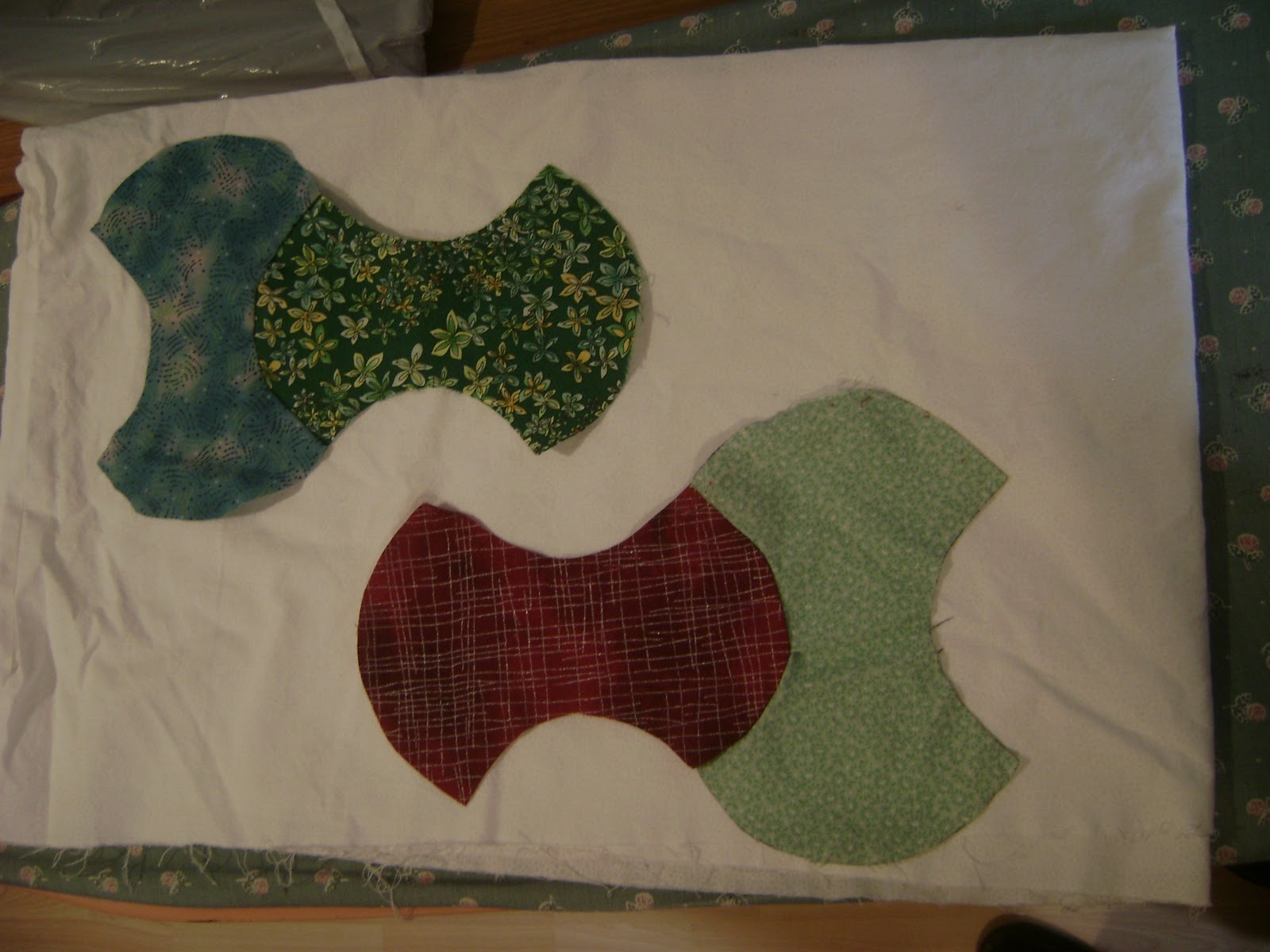
Here’s what the pieces look like. Individual pieces:
Yes, I made a template, and drew on fabric, and cut each of these out by hand. I have...about 400, I think.
Then I sew them into pairs, like so:
Then, I sew the pairs into foursomes:
Then, I sew them into larger pieces, joining two foursomes into, um, eightsomes (??) and so on. All by hand. Yes, this is why it's taking me years (in addition to the fact that I am doing other things in the meantime).

This is my quiet-time-on-the-couch project.  I have been working on this piece for so long I can see my development in it, as a person, mom, aunt, daughter, as well as as a quilter. It includes fabrics from projects long since finished: it includes fabrics from clothes I made for the kids when they were babies, and for all the other kids-nieces and nephews-since. It includes fabric given to me by my sister in law when she got rid of her “stash” and fabric left over from a dress that belonged to my other sister in law’s mother (when she, the mother, was a teen). It includes fabrics from Halloween costumes and several wedding canopies I’ve made (including my own). It’s wonderful to sit and sew it, covered in it, and see my story grow with the quilt.
 
I don’t know any more how long I’ve been working on it, and it is very slow going. However, last winter I got sick and while sick is no fun, it did give me lots of time on the couch. Suddenly the quilt, as quilts do, started taking shape. The moment when you feel you’ve moved from “a bunch of pieces of fabric” to a single, cohesive piece, is wonderful, and very gratifying.

Another plus to hand-piecing is that I can take it with me: portable project! Around this time, I brought some pieces to my parents’ on a night we were having dinner there. I was talking about it with my mother, and sister-in-law, and the subject of a recipient for this piece came up. I said I don’t have one in mind and that I am waiting until the recipient makes her/himself known. At this point my mother said that since the bed spread I made for her and my father (one of my first pieced pieces) is going on 14 years old, she’d like to ask for this one as a bed spread. And I found my recipient!

In order for the piece to cover my parents’ queen sized bed generously, I needed to cut more pieces, and keep enlarging the piece. Back I went to the template and my fabric stash. I cut some fabric from more recent projects and started sewing them together.

This past week I was ill, and on the couch, again, and in between naps I did some sewing. I hope to have the piece done this winter, by my parents’ anniversary month.
I’ll post pictures, and more of this quilt’s journey, when it’s done.